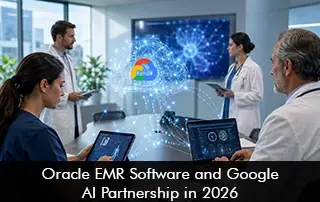
Taking their AI partnership forward this year, Oracle EMR software and Google have announced an expansion of AI functionalities. On July 30th, 2026, Oracle announced that Google’s Gemini application will be available for its users across its enterprise applications. This will enable businesses to use AI in their everyday workflows and streamline processes to optimize tasks. Users of Oracle Fusion Applications and Oracle NetSuite can benefit from leveraging robust AI functionalities. This partnership aims to empower organizations by helping them make faster decisions and get greater value from AI.
Why Does this Partnership Matter for Healthcare?
Administrative workload is a nightmare for busy clinics and hospitals. Healthcare providers spend a lot of time on documentation, reviewing patient information, and communicating with staff members. To cut down on this everyday workload, AI plays a crucial role. AI agents available in the electronic medical records software can automate and streamline some of these repetitive tasks.
The important point to note is that this AI partnership doesn’t replace the human touch but aids providers by taking care of the routine work. These workflow enhancements can make a difference in healthcare by giving doctors more time to focus on their patients, make meaningful interactions, and even improve their workflow balance.
Flexibility with AI Models from Oracle EMR Software and Google’s Partnership
Oracle EHR software seems to recognize that healthcare providers desire flexibility and greater choice in AI models. Oracle plans to ensure that organizations can select different AI models depending upon their needs.
This flexibility can be useful for healthcare organizations, as it can strike a balance when it comes to managing performance, costs, and patient data security.
What Does this Partnership Mean for EMR Software?
This AI partnership is relevant to the future of EHR systems. Modern EMR software solutions do a lot more than just storing patient records. They have billing tools, patient engagement solutions, and practice management capabilities.
Oracle EMR software has integrated capable AI agents that can make these platforms more interactive than ever. Earlier, physicians had to manage multiple screens and tasks manually. But now, with smart AI expansion, many tasks can be handled automatically with a single request. The AI functionalities give providers greater control and slash the amount of manual work put into, for example, gathering or summarizing patient information.
Healthcare organizations will need to introduce the technology cautiously, as it is still in its early stages of development. However, AI may become a much more useful component of routine healthcare operations when platforms like Oracle EMR software make sophisticated AI models more available within their current software platforms.