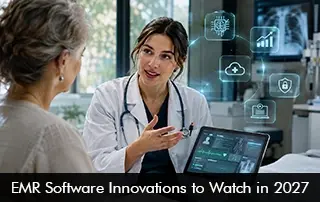
Healthcare technology has rapidly evolved over the past few years. Of course, for the better. Gone are the days when EMR software systems acted as digital storage cabinets. Modern platforms offer useful capabilities to streamline clinical, administrative, and financial processes. AI, automation, and patient engagement solutions have advanced considerably. In 2027, we can expect EHR systems to become more intelligent, connected, and predictive.
Rather than EMR software vendors rolling out more tools. They will focus on addressing daily healthcare challenges related to workflow shortages, rising costs, and clinician burnout.
AI Role in EMR Software Will Expand
Ambient AI documentation tools in electronic medical records software like AdvancedMD EHR software and athenaOne software were a major focus in 2026. AI integrations worked in the background, listening to patient and provider interactions and then automatically drafting structured notes.
In 2027, the role of AI will definitely expand beyond clinical documentation. It can help clinicians identify missing information, summarize patient history in seconds, and highlight any gaps in care. These functionalities can help alleviate the issue of physician burnout and give providers more time to focus on patient care.
Interoperability and Prior Authorization Will Advance
Interoperability is a prime focus for healthcare. Smooth data exchanges are necessary for different systems to connect and share information. In 2027, EMR software vendors will prioritize FHIR-based connections and work on integration opportunities with labs, pharmacies, hospitals, and healthcare organizations.
The CMS Interoperability and Prior Authorization Final Rule will apply in 2027. Under the new rule, valid payers need to implement FHIR-based APIs for the electronic prior authorization process and better data exchanges. This provides an opportunity for EHR software vendors to develop connections with health plans and help practices with authorization requests.
More Personalized Patient Engagement
Patient portal EMR software and automatic reminders are common and reliable solutions used by modern practices to propel patient engagement. In 2027, patient engagement can become more individualized and patient-centered. This could eventually lead to more meaningful patient interactions and involvement.
To keep up with patient demands, AI-assisted communication tools will be broadly leveraged. AI-based communication can reduce communication delays and help patients understand their care plans in simpler language. For providers, this can be good news, as engaged patients are more likely to follow care plans, adhere to medications, and are encouraged to develop strong bonds.
How Proactive EMR Software Will Take on Innovation
EHR software vendors that will stand out in the coming year will be those that respond to practice challenges. They then develop solutions around them that fit naturally into existing workflows.
There can be more investment in artificial intelligence, cloud infrastructure, and intuitive interfaces. Vendors need to assure their users that AI tools are reliable and comply with healthcare regulations so providers can use them. Moreover, successful innovations will be based on consistent feedback from clinicians, nurses, and other staff members. The next chapter of EMR software innovation looks bright, with better integrations and interoperability making way for a meaningful change.