2026 has been a lucky year for healthcare technology innovations. This is especially true when we talk about AI integrations in EMR software. Earlier, AI’s role in healthcare was limited in terms of automating tasks. Now, the role has expanded with improved AI integrations in EHR software. Vendors in 2026 are not treating AI as an add-on feature but are designing intelligent solutions that can be easily utilized by physicians and staff members to streamline clinical, administrative, and financial processes. This year, we saw AI move from basic AI-propelled documentation to smarter automation.
How has AI enhanced EMR software?
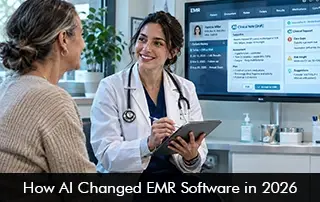
AI has shown great potential when it comes to clinical documentation. AI-assisted documentation in electronic medical records software has simplified time-consuming charting tasks. AI works silently in the background; it listens to patient and provider conversations and documents them as structured clinical notes. AI has become more sophisticated by suggesting diagnoses and follow-up actions based on the conversation. The good thing is that the clinician can review the note and make any adjustments if needed.
Beyond documentation, AI is assisting clinicians with their daily workload. AI tools in EMR software can summarize lengthy patient histories in seconds; they can pinpoint care gaps and help with tedious medical coding.
What are EHR software vendors doing in 2026?
This year, major EMR software vendors are expanding AI capabilities in their platforms.
Epic Systems
Prominent EHR software vendor Epic EMR software released its AI charting in February 2026. This is part of the Art AI Suite. The new feature is designed to listen to patient conversations and draft clinical notes. Epic’s platform offers AI support for billing, patient engagement, and even chart summaries.
athenaOne EMR Software
The vendor made its AI-native platform readily available in August this year. The athenaOne EHR software made its AI-native platform accessible to 170,000 clinicians. The users can benefit from seamless AI integrations to be used without having to switch applications. The ambient solution can draft notes and recommend order types by listening to real-time patient and provider encounters. The platform can help clinicians identify care gaps and improve health outcomes.
MEDITECH EHR Software
At HIMSS26, MEDITECH EMR software expanded its AI portfolio. The new tools included documentation features for nurses and physicians. It also introduced an intelligent assistant to help clinicians explore patient records.
These AI developments in EHR software indicate that vendors are focusing on introducing AI tools that offer practical solutions to everyday issues.
The Future of AI in EMR Software
With improved integrations and interoperability, the future of AI in EHR software looks bright. AI tools can enable providers to identify follow-up care and even pinpoint patients who are at a higher risk. AI functionalities can support providers in taking a more proactive approach in healthcare. As interoperability improves, AI can help bring patient records from different sources together. This can give a clearer picture of patients’ conditions to provide better care.
AI is not here to replace physicians’ and clinicians’ judgment. The role of AI is to make clinicians’ lives easier. We can also expect AI to become a part of everyday healthcare to alleviate billing challenges and make way for smoother communications.