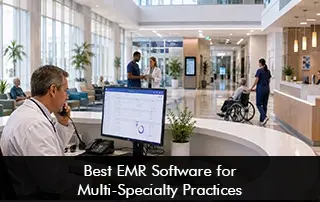
The requirements of a multi-specialty practice differ from those of a small single-specialty practice. It requires an EMR software platform that can handle the complexities and workflows of various medical specialties. These can include primary care, cardiology, dermatology, behavioral health, and more. The best EHR software for multi-specialty clinics is one that can keep patient information connected and efficiently support diverse clinical processes.
The Growing Scope of Multi-Specialty Clinics in the USA
Multi-specialty healthcare has become important over the years. According to the American Medical Association’s data published in 2024, 27.8% of clinicians worked in specialty clinics. The percentage rose from 21.8% in 2012. Furthermore, more physicians want to work in practices with more than 50 providers.
This growth shows that there is a greater demand for larger physician practices and integrated care. Patients also benefit by seeing different specialists under one roof. For EMR software vendors, this creates a market to introduce platforms that can support better interoperability and meet the demands of multiple specialties and locations.
Best EMR Software for Multi-Specialty Groups in 2026
Epic EHR Software
Epic Systems is a strong choice for large multi-specialty organizations. These can include healthcare organizations, academic centers, and large physician groups. The Epic platform can handle complex workflows with its broad functionality. Epic EMR software can support different medical specialties and offer robust integrations. It should be kept in mind that the software implementation process can be tough and require planning, training, and configuration.
athenaOne EMR Software
For growing multi-specialty practices, the athenaOne EHR software platform is a solid choice in 2026. The athenaOne platform is a comprehensive solution with features of practice management, patient engagement, and revenue cycle management. The platform provides strong interoperability to support care coordination and smooth data exchange between different specialists.
NextGen Healthcare
NextGen EMR software is a pertinent option for ambulatory multi-specialty organizations. The all-in-one solution offers billing, documentation, patient engagement, practice management, and analytics. So an organization with different specialties can benefit from a single integrated platform. NextGen Healthcare users have noticed that the experience relies greatly on configuration.
eClinicalWorks EHR Software
Multi-specialty ambulatory groups that want a flexible platform can implement eClinicalWorks EMR software. The vendor has a reliable presence in the ambulatory EHR market. The platform has extensive features like billing, telehealth, patient engagement, and practice management that can be easily used by different medical specialties. However, users have reported that the number of features in the EMR system can make the platform complex to use.
What Should a Multispecialty Clinic Look for in an EHR Software?
An electronic medical records software for a multispecialty clinic needs to be flexible enough to handle different workflows. The EMR software should have,
- Specialty-specific templates
- Intuitive scheduling software for various providers and locations
- Integrated billing and RCM software
- Digital communications to keep patients engaged and maintain quick contact
- Robust interoperability with hospitals, pharmacies, labs, and other systems.
- AI-powered solutions that are practical
- Efficient support for multiple locations and providers
The ideal EMR software isn’t the one with the most features. It’s the one that allows different specialists, nurses, front-office staff, billers, and administrators to work smoothly with the same connected system.