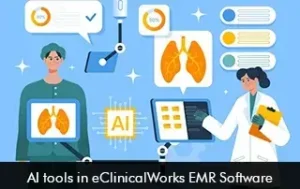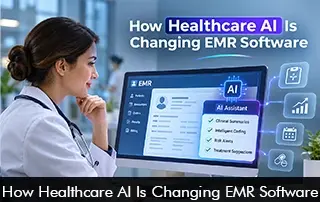
Healthcare is evolving rapidly, with AI integrations in EMR software. AI’s role is growing and becoming part of daily workflows. These EHR software innovations can help providers document, quickly find information, identify patient risks, and streamline operational and financial processes.
AI is now deeply integrated into EMR platforms, making them more intelligent and able to actively support providers. EMR systems are no longer digital storage cabinets, but they are robust solutions that can empower care teams throughout the patient care journey. In this blog, we will explore the latest AI innovations in EHR software and what can be expected in the near future.
How is AI Transforming EMR Software?
This is the golden question. Traditionally, healthcare providers have always been under immense pressure and cognitive stress, mainly due to time-consuming documentation. The whole scenario is changing for the better with ambient AI tools in electronic medical records software. These solutions can listen to patient and provider interactions and generate clinical notes in a matter of seconds. This can reduce documentation load and lead to more meaningful patient encounters. Modern software vendors like athenaOne EMR software, AdvancedMD EHR software, and others offer AI capabilities for clinical documentation.
AI is also making an impact when it comes to making patient information easier to access. Instead of providers searching through lengthy patient records, they can now benefit from AI-powered search tools. These functionalities can help clinicians find relevant information related to diagnoses, medication history, and lab results in a breeze. This can lead to great time-saving benefits.
Another application of AI in EMR software is in clinical decision support. AI is designed to analyze patient information to identify potential risks and even missing documentation. Providers can make more informed decisions at the point of care with AI recommendations.
Innovative AI Capabilities Offered by Modern EHR Software Vendors in the USA
To keep up with healthcare demands and alleviate everyday challenges, prominent EMR software vendors are rolling out AI functionalities. These features can be easily implemented and can provide practical solutions.
In August 2026, the athenaOne EHR system expanded its AI-native capabilities to more than 170,000 clinicians. Its ambient AI solution can automatically generate clinical notes and even recommend orders from patient conversations.
Joining the bandwagon, Oracle Health EMR software also expanded its AI clinical agent in August 2026. The new functionalities introduced were coding, dictation, and robust chart review tools for users.
Another interesting development came from Epic Systems. Epic EHR software rolled out the Epic Connectors in October 2026. This feature allows its AI assistants and other applications to retrieve information and perform tasks across third-party applications. For example, via AI connectors, an ambulance’s estimated arrival time can be pulled out from an external app into Epic software, helping emergency teams to be well-prepared.
What can we expect from AI in EMR software in 2027 and beyond?
In the next year, we can expect AI tools in EMR systems to be more advanced and tuned to handle multiple tasks. For instance, an AI agent can prepare patient charts, identify any missing information, and even assist with follow-up scheduling. Predictive analytics is also an area that will advance. AI’s role in patient engagement and communications is also likely to expand. AI-powered tools can lead to more personalized communications and help patients understand treatment instructions and even manage appointments.
However, these advancements require careful implementation. Software vendors need to consider factors such as patient privacy, data security, and accuracy with AI. AI is not here to replace the physician; AI’s role is to assist providers and alleviate workload pressure so they can concentrate on patient care.