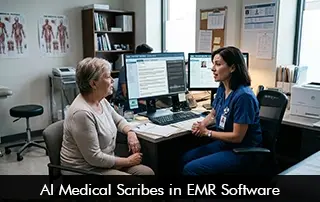
Making patient encounters meaningful has been a challenge as providers type notes in EMR software. This can take away attention from the patient. With AI medical scribe functionality, patient and provider interactions are becoming more wholesome. Fortunately, AI works in the background, listening to provider and patient encounters to generate clinical notes. Instead of writing from scratch and being distracted, clinicians can easily review the draft, make any edits, and add it to the patient’s chart. AI medical scribes are an important revolution in US healthcare, as they have streamlined medical documentation.
How Do AI Medical Scribes Work with EMR Software?
Modern electronic medical records software offers AI medical scribes. These scribes utilize the power of artificial intelligence technology to capture conversations with the patient’s permission. They can efficiently identify details like symptoms, medical history, findings, and the clinician’s treatment plan. These conversations are turned into clinical notes, often in SOAP note format.
This provides an opportunity for the provider to focus on their patient without having to worry about typing notes. The first draft is prepared by the AI medical scribe; the clinician has the flexibility to review and change it if needed.
Which EMR Software vendors offer AI Medical Scribes?
To automate tedious documentation processes, the EHR software must offer AI medical scribe functionality. Either the capability is directly available with the EMR platform, or it’s available via partnerships with AI companies.
Epic EMR software offers ambient documentation tools to make life simple for physicians. The AI scribe is built directly into Epic Systems. It is designed to draft clinical notes during appointments and can even suggest orders. This ensures that the clinician can utilize AI without having to switch between different applications. Furthermore, the AI medical scribe can also help with nursing documentation; it can automatically capture assessments.
Ambient notes technology is also a part of athenaOne EHR software. The athenaAmbient provides practical solutions by automating routine documentation tasks. Draft notes can be generated quickly and are available within the athenaOne workflows.
Understanding the burnout and cognitive load that comes from clinical documentation tasks, eClinicalWorks software provides its users with Sunoh,ai. The AI medical scribe captures patient-provider conversations and generates clinical notes. It can also capture orders and create visit summaries that can be added to the patient’s chart. The scribe can be integrated with different EHR software systems as well, including Practice Fusion, Tebra EMR software, and Oracle Health.
How are AI Scribes Transforming Healthcare in the USA?
AI medical scribes are used at scale in the United States. For example, at Cleveland Clinic, more than 4000 clinicians used the AI scribe by Ambience Healthcare. The AI scribe was a hit for drafting structured notes in Epic EMR software and for creating after-visit summaries. During the initial phase, the AI scribe was used for one million patient encounters.
AI medical scribes in EHR systems were also utilized by The Permanente Medical Group. About 25 million encounters were handled by the scribe, resulting in saving 15,700 hours of documentation time for clinicians. These use cases suggest that AI medical scribes have transformed medical documentation and can meet the growing documentation demands. When provider burnout is kept at bay, they can focus on caring for their patients and worry less about typing and drafting notes manually.